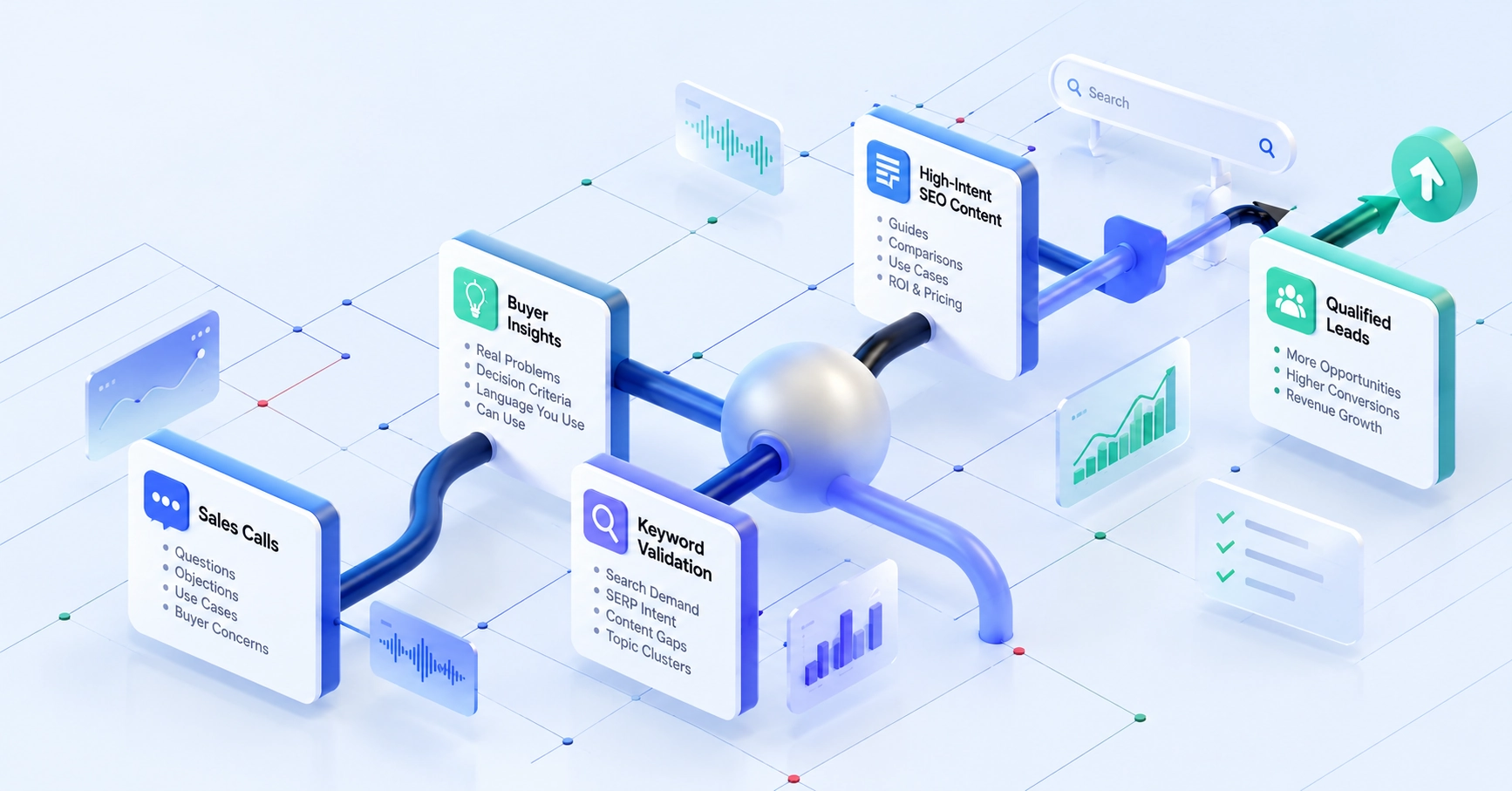
Keyword research tells you what people search for. Sales calls can reveal something equally valuable: what potential customers actually care about when a purchase is on the line.
Prospects ask about pricing, implementation, alternatives, risks, integrations, results, timelines, and whether a solution will work for their specific situation. Those conversations can uncover high-intent SEO topics that traditional keyword research may overlook.
The goal is not to publish call transcripts or turn every customer question into a blog post. It is to identify recurring buyer signals, validate them against search behavior, and turn the strongest opportunities into useful content that helps prospects make decisions.
This guide explains how to build that process from sales call to published SEO content.
What Is High-Intent SEO Content?
High-intent SEO content targets searches made by people who have a defined problem and are moving toward evaluating or choosing a solution.
Instead of focusing only on broad informational searches, high-intent content frequently addresses questions such as:
- •Which solution is right for my situation?
- •How much will this cost?
- •How does option A compare with option B?
- •Will this work with my existing technology?
- •What are the risks or limitations?
- •How long will implementation take?
- •What results should I realistically expect?
- •What should I evaluate before choosing a provider?
These questions often appear during sales conversations because prospects have moved beyond basic awareness.
That makes sales calls a useful source of buyer-intent research.
Why Sales Calls Can Reveal Better SEO Opportunities
Traditional SEO research usually begins with search queries, keyword volume, competitors, SERPs, and related questions.
That data remains essential.
But keyword tools primarily show search behavior. Sales conversations add another layer: the business context behind that behavior.
A prospect might never use your preferred industry terminology. Instead, they may describe a practical problem:
“Can we do this without replacing our existing system?”
That question could reveal several potential content opportunities involving migration, compatibility, integrations, implementation costs, or alternatives.
Another prospect might ask:
“Why should we choose this instead of doing it internally?”
That can reveal comparison and build-vs-buy intent.
The value is not the wording of one question. The value appears when similar concerns repeatedly surface across qualified opportunities.
The Sales Call to SEO Content Framework
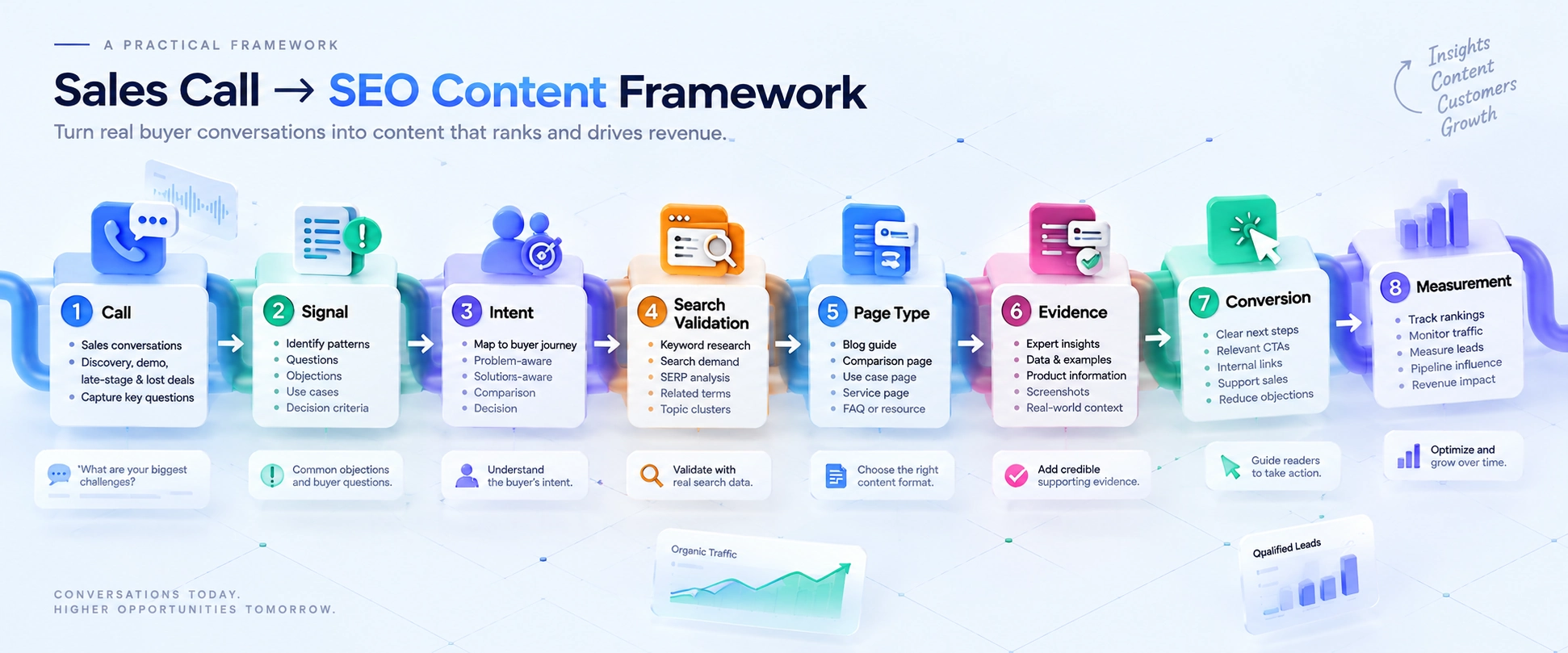
A reliable process can be organized into eight stages:
| Stage | Question to Answer |
|---|---|
| Call | What did the prospect actually ask or worry about? |
| Signal | Is it a problem, objection, comparison, requirement, or decision criterion? |
| Intent | Where is the prospect in the buying journey? |
| Validation | Do people search for this problem or closely related language? |
| Page Type | Which content format best satisfies that intent? |
| Evidence | What information is required to answer accurately? |
| Conversion | What logical next action should the reader take? |
| Measurement | Does the content influence qualified traffic, leads, or opportunities? |
This prevents teams from treating interesting sales conversations as automatic blog ideas.
Start With the Right Sales Conversations
Different conversations reveal different types of search intent.
Discovery Calls
Discovery calls expose problems, frustrations, existing processes, and desired outcomes.
Look for phrases such as:
- •“We are struggling with…”
- •“Our current process takes…”
- •“We need a way to…”
- •“The biggest problem is…”
These insights often produce problem-aware educational content.
Product Demos
Demo conversations tend to reveal evaluation criteria.
Prospects may ask about:
- •Features
- •Integrations
- •Customization
- •Limitations
- •Compatibility
- •Implementation
- •User roles
- •Security
- •Scalability
These questions can support feature pages, comparison content, use-case pages, or implementation guides.
Late-Stage Sales Calls
Late-stage conversations are especially useful for high-intent SEO because prospects may already understand the available solutions.
Their remaining concerns often involve:
- •Pricing
- •ROI
- •Procurement
- •Implementation risk
- •Support
- •Contracts
- •Security
- •Migration
- •Stakeholder approval
These can become strong commercial investigation topics.
Closed-Lost Opportunities
Lost deals can be just as informative as successful ones.
Look for repeated reasons prospects decided not to move forward.
Was the price unclear?
Did implementation appear difficult?
Was a competitor perceived as better suited to a particular use case?
Was an important integration missing?
Did stakeholders fail to understand the ROI?
Some of these problems may require product changes rather than content. But when a prospect simply could not find or understand the information needed to make a decision, there may be a content gap.
Protect Customer Privacy Before Mining Calls
Sales recordings should be treated as customer data rather than unrestricted marketing material.
For US businesses, recording requirements deserve particular attention because federal and state rules can differ. Federal law generally establishes a one-party-consent baseline, while some states impose all-party consent requirements. Interstate calls can introduce additional complexity depending on where participants are located.
Before using recorded conversations for content research:
- •Establish a documented recording and consent process.
- •Restrict access to recordings and transcripts.
- •Remove names and personally identifiable information from research notes.
- •Remove confidential commercial information.
- •Avoid publishing identifiable customer statements without appropriate permission.
- •Review requirements for regulated industries.
- •Consider legal review when calls involve participants in different jurisdictions.
- •Review the data policies of any AI system before uploading transcripts.
The safest content strategy is usually to extract recurring patterns rather than publish individual conversations.
You need the buyer insight, not the buyer’s identity.
Extract Signals Instead of Collecting Quotes
Do not start by searching transcripts for sentences that sound good in an article.
Extract structured signals.
For every relevant call, record information such as:
| Signal | What It May Reveal | Potential Content |
|---|---|---|
| Repeated question | Information gap | Guide or FAQ |
| Objection | Conversion barrier | Objection-handling article |
| Competitor comparison | Evaluation intent | Comparison page |
| Pricing question | Commercial intent | Pricing or cost guide |
| Integration concern | Technical requirement | Integration page |
| Implementation concern | Adoption risk | Implementation guide |
| Industry-specific question | Vertical need | Industry/use-case page |
| ROI question | Business justification | ROI guide |
| Alternative requested | Active solution research | Alternatives page |
This creates structured research instead of a folder full of transcripts.
Look for Patterns Across Multiple Calls
One unusual question is not automatically an SEO opportunity.
Repeated patterns are much more useful.
Suppose one prospect asks whether a software platform integrates with Salesforce. That could be account-specific.
If the same integration question appears across 15 qualified opportunities, however, the signal becomes much stronger.
Review patterns across:
- •Customer segments
- •Company sizes
- •Industries
- •Buyer roles
- •Deal values
- •Sales stages
- •Won opportunities
- •Lost opportunities
This helps separate isolated comments from recurring buyer needs.
Use a Simple Opportunity Score
A practical scoring model can use five factors.
Score each from 1 to 5:
Frequency
How often does the question appear?
Commercial relevance
How closely is the topic connected to purchasing?
Search demand
Can you verify related search behavior?
Content gap
Does your site already answer the question properly?
Business fit
Can your company genuinely provide a useful solution?
A topic scoring highly across these dimensions deserves closer attention.
Importantly, this is an internal prioritization framework—not a Google ranking formula.
Translate Buyer Language Into Search Language
Customers and SEO tools rarely use identical terminology.
A buyer may say:
“How difficult will it be to move everything from our old system?”
Keyword research might reveal searches around:
- •legacy system migration
- •software migration
- •application modernization
- •legacy modernization
- •system migration strategy
- •legacy software replacement
Do not force the customer’s exact wording into the article.
Instead:
- •Capture the original buyer problem.
- •Identify its underlying concept.
- •Research how that concept appears in search.
- •Inspect the SERP to understand expected content.
- •Build the page around both search intent and real buyer needs.
This combines the commercial intelligence of sales with the discoverability data of SEO.
Validate Every Topic With SEO Research
Sales data should complement keyword research, not replace it.
Before creating a page, investigate:
- •Search volume
- •Keyword variations
- •SERP intent
- •Ranking page types
- •People Also Ask questions
- •Related searches
- •Competitor coverage
- •Existing pages on your own site
- •Keyword difficulty where useful
- •Commercial relevance
A low-volume keyword should not automatically be rejected.
A search query used by 100 highly qualified prospects can be more valuable to a business than a broad informational keyword bringing thousands of visitors with little buying intent.
The appropriate metric depends on the business objective.
Match the Question to the Right Page Type
One of the biggest mistakes in content marketing is assuming every keyword deserves a blog post.
It does not.
The page format should match the searcher’s task.
| Buyer Need | Recommended Content Type |
|---|---|
| Understand a problem | Educational guide |
| Learn how to solve something | How-to article |
| Compare solutions | Comparison page |
| Find alternatives | Alternatives page |
| Evaluate a provider | Service or solution page |
| Determine industry fit | Industry page |
| Understand costs | Pricing/cost guide |
| Evaluate financial value | ROI guide |
| Reduce implementation risk | Implementation guide |
| Verify compatibility | Integration page |
| Answer recurring concerns | FAQ or supporting section |
Always inspect what currently satisfies the query before choosing the format.
If users searching a term overwhelmingly want a commercial landing page, publishing a 3,000-word informational article simply because it is easier to produce may misalign with intent.
Turn Sales Objections Into Useful Content
Objections are particularly valuable because they expose what prevents buyers from moving forward.
Common categories include:
Cost
Questions might include:
- •Why does this cost so much?
- •What affects the price?
- •Is there a lower-cost alternative?
- •When does the investment pay off?
Potential content:
- •Pricing guides
- •Cost breakdowns
- •ROI articles
- •Build-vs-buy comparisons
Risk
Questions might include:
- •What happens if implementation fails?
- •Will this disrupt operations?
- •Is our information secure?
- •How difficult is migration?
Potential content:
- •Implementation checklists
- •Security explainers
- •Migration guides
- •Risk-management articles
Fit
Questions might include:
- •Is this suitable for a small company?
- •Does this work in healthcare?
- •Can an enterprise use it across multiple locations?
Potential content:
- •Industry pages
- •Company-size pages
- •Use-case guides
- •Solution pages
Good objection content should answer the concern fairly. Do not disguise a sales pitch as an educational article.
Build Content Around Decision Criteria
Competitor comparisons often focus on features.
Buyers frequently care about broader decision criteria.
Depending on the product or service, those criteria might include:
- •Total cost
- •Implementation time
- •Integrations
- •Ease of use
- •Scalability
- •Support
- •Security
- •Customization
- •Contract requirements
- •Maintenance
- •Training
- •Internal resources required
A useful comparison article explains when each option makes sense rather than declaring your solution the winner in every scenario.
That transparency can make commercial content more credible.
Create a Content Brief Before Writing
Once a topic has been validated, create a short evidence-based brief.
Include:
Primary buyer question
What does the prospect actually need answered?
Search intent
Informational, commercial, transactional, or mixed?
Funnel position
Problem awareness, solution awareness, evaluation, or decision?
Primary keyword
What search query best represents the need?
Related concepts
Which entities, questions, and secondary terms belong naturally in the discussion?
Sales evidence
What recurring pattern triggered the topic?
Required evidence
Which product facts, research, examples, documentation, screenshots, or expert input are needed?
Page format
Blog, service page, comparison page, use-case page, integration page, or another format?
Internal links
Which pages should logically connect to this content?
CTA
What is the most appropriate next action for someone at this stage?
A precise brief prevents writers—and AI systems—from turning a commercially useful insight into generic SEO copy.
Write for the Buyer, Not the Keyword
High-intent content should answer the main question quickly.
A useful section structure is:
Direct answer → explanation → evidence → example → decision guidance
For example, if someone asks:
How Long Does Software Migration Take?
Do not begin with several paragraphs explaining the history of software migration.
Give the useful answer first.
Explain that timelines depend on system complexity, data volume, integrations, testing requirements, security requirements, and migration strategy. Then provide realistic scenarios or documented company-specific information where available.
This structure improves readability and also makes important passages easier for search engines and AI systems to interpret.
Google’s guidance emphasizes creating helpful, reliable content primarily for people rather than content created mainly to manipulate search rankings.
Use AI Without Inventing Buyer Insights
AI can speed up this workflow considerably.
It can help:
- •Group similar questions.
- •Categorize objections.
- •Identify repeated themes.
- •Create initial topic clusters.
- •Summarize sanitized notes.
- •Generate content briefs.
- •Suggest related questions.
- •Draft outlines.
- •Produce first drafts.
- •Suggest internal-link opportunities.
But AI should not invent:
- •Customer quotes
- •Customer results
- •Case studies
- •Product capabilities
- •Revenue numbers
- •Research
- •Testimonials
- •Competitive claims
Human review remains important because the value of this strategy comes from real buyer evidence.
If AI fills evidence gaps with plausible-sounding information, the process loses the very advantage sales-call research provides.
Be Careful When Sending Customer Data to AI Tools
Removing a customer’s name does not automatically make a transcript safe to share.
A conversation may contain:
- •Email addresses
- •Phone numbers
- •Company information
- •Financial information
- •Contract details
- •Internal technology
- •Security concerns
- •Employee information
- •Proprietary processes
Create a sanitization process before transcripts enter an AI workflow.
At minimum, determine:
- •What information can be processed?
- •What must be removed?
- •Which employees can access the data?
- •Which AI tools are approved?
- •How those providers handle submitted information.
- •How long information is retained.
- •Whether your customer agreements impose additional restrictions.
For sensitive industries, involve appropriate legal, security, or compliance personnel rather than treating transcript processing as purely an SEO workflow.
Connect High-Intent Articles Through Internal Links
A high-intent article should rarely exist as an isolated page.
Connect it to the next useful resource.
For example:
Problem guide → solution page
Comparison article → relevant service page
Implementation article → integration or technical documentation
Industry article → industry-specific service
Pricing guide → consultation or quote page
Case study → relevant solution
Internal links should make the buyer journey easier, not merely distribute SEO authority.
A reader who understands their problem should be able to discover the next piece of information without returning to Google.
Prevent Keyword Cannibalization
Sales teams may repeatedly raise related questions that sound like separate topics but belong on the same page.
For example:
- •How much does SEO cost?
- •SEO pricing
- •Average SEO agency cost
- •Monthly SEO services cost
- •How much should a company spend on SEO?
These may represent one search-intent cluster rather than five separate articles.
Before creating a new URL, ask:
- •Does an existing page already satisfy this intent?
- •Could the new information improve an existing page?
- •Are the SERP results substantially different?
- •Does the query represent a genuinely different buyer task?
- •Would separate pages compete for the same searches?
Sometimes the best content opportunity is an update, not another URL.
Measure Revenue Impact, Not Just Traffic
Sales-derived SEO content should be evaluated beyond pageviews.
Measure performance across the funnel.
| Layer | Useful Metrics |
|---|---|
| Search visibility | Impressions, rankings, organic clicks |
| Engagement | Relevant on-page engagement and next-page actions |
| Conversion | Qualified forms, calls, demos, trials |
| Pipeline | Opportunities influenced by organic content |
| Sales enablement | Content shared by sales representatives |
| Revenue | Qualified pipeline and revenue influenced where attribution permits |
The most valuable article may not be the one receiving the most traffic.
Imagine two pages:
Article A: 20,000 organic visits and very few qualified inquiries.
Article B: 800 visits and repeated influence on qualified sales opportunities.
For a revenue-focused SEO program, Article B may be substantially more valuable.
Traffic is a distribution metric. Business impact requires additional measurement.
Build a Sales-to-SEO Feedback Loop
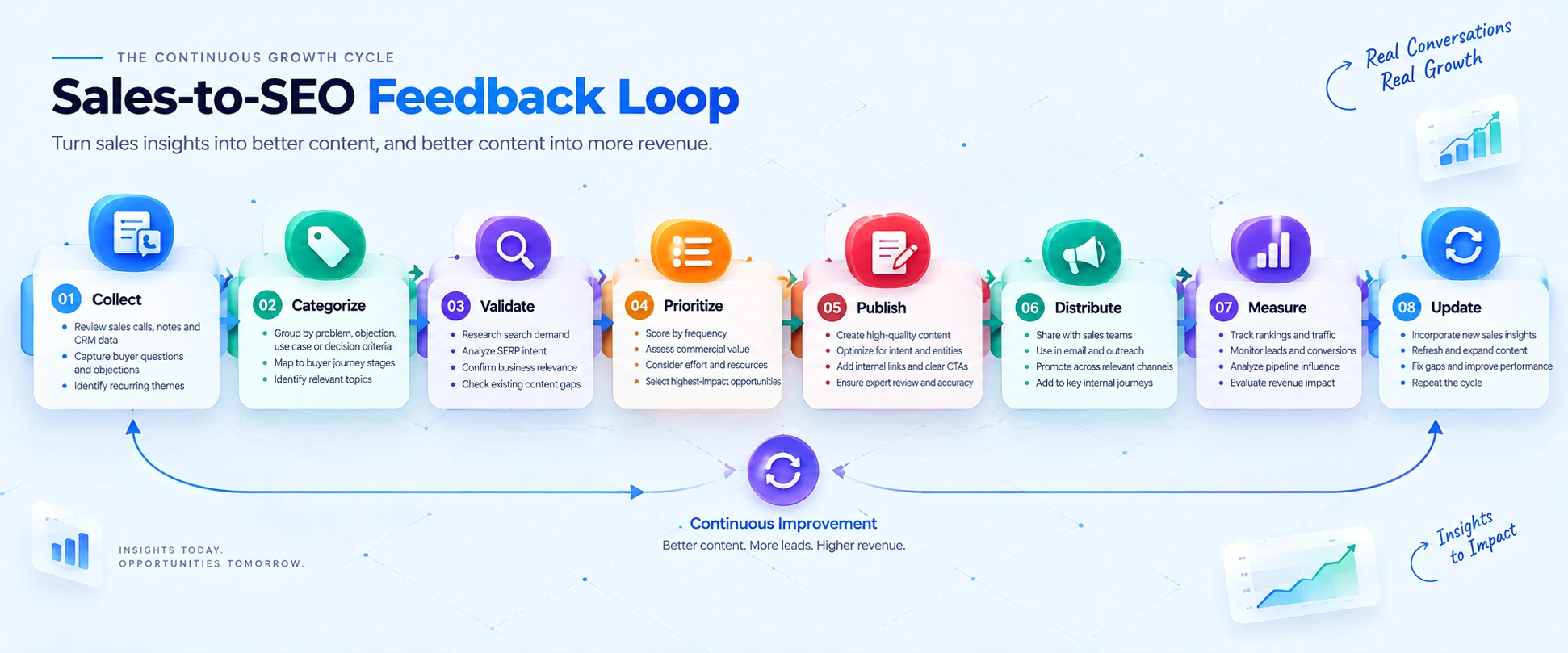
The process should continue after publication.
Sales teams can tell SEO teams whether prospects are still asking the same questions.
SEO teams can tell sales teams which buyer questions are gaining organic visibility.
A simple recurring workflow looks like this:
Collect → categorize → validate → prioritize → publish → distribute → measure → update
After publishing an article, ask sales:
- •Are prospects reading it?
- •Are representatives sending it after calls?
- •Does it answer the objection?
- •What questions remain unanswered?
- •Has the objection changed?
- •Are new competitors being mentioned?
Those answers can improve existing content and identify new opportunities.
Common Mistakes to Avoid
Publishing Content From a Single Conversation
One conversation can inspire research, but it rarely proves widespread demand.
Validate the idea before allocating significant resources.
Publishing Customer Information
Do not expose private or identifiable details simply because they appear in a transcript.
Using Only Search Volume
Commercial relevance and qualified demand matter too.
Turning Every Insight Into a Blog
Match the format to the intent.
Copying the Prospect’s Exact Language Without Research
Buyer language is an input. Search validation determines how that problem should be translated into an SEO opportunity.
Writing Thin Comparison Pages
Useful comparison content should discuss tradeoffs, use cases, limitations, costs, and decision criteria where evidence is available.
Letting AI Invent Evidence
A polished false claim is still a false claim.
Measuring Success Only Through Traffic
If the objective is pipeline growth, track qualified actions and sales influence alongside organic visibility.
A Practical Example
Imagine a B2B software company repeatedly hears this question:
“Can we replace our legacy system without disrupting daily operations?”
Step 1: Capture the signal
The underlying concern is migration risk and business continuity.
Step 2: Check repetition
The question appears across multiple qualified opportunities.
Step 3: Translate it into search concepts
Research may uncover relevant queries around legacy system migration, legacy modernization, migration planning, application modernization, and reducing migration risk.
Step 4: Inspect search intent
Determine whether searchers want a guide, service provider, checklist, technical documentation, or another format.
Step 5: Choose the page
A practical guide could explain migration planning and link naturally to the company’s legacy modernization service.
Step 6: Add evidence
Bring in technical experts to explain migration approaches, testing, rollback planning, dependencies, and realistic limitations.
Step 7: Publish and connect
Internally link the article with related modernization, consulting, migration, and case-study pages.
Step 8: Measure
Monitor organic visibility, qualified inquiries, sales usage, and whether prospects continue raising the same concern.
One recurring sales objection has now become an SEO asset, sales-enablement resource, and source of buyer education.
FAQ
What is high-intent SEO content?
High-intent SEO content addresses searches closely connected to solving a defined problem, evaluating solutions, comparing providers, understanding costs, reducing risk, or making a purchase decision. It often attracts fewer visitors than broad informational content but can reach users closer to conversion.
How can sales calls improve keyword research?
Sales calls reveal the problems, objections, decision criteria, and terminology used by actual prospects. SEO teams can translate those signals into search concepts and validate them using keyword and SERP research.
Should every sales question become a blog post?
No. Repeated questions should first be validated for business relevance and search intent. Some belong in existing pages, FAQs, service pages, comparison pages, help documentation, or sales collateral rather than standalone blog posts.
Which sales calls are most useful for SEO research?
Discovery calls can expose problems, demos can reveal evaluation criteria, late-stage conversations can uncover risk and pricing concerns, and closed-lost opportunities can reveal unresolved objections. Using several stages gives SEO teams a more complete view of buyer intent.
Can AI analyze sales call transcripts for SEO ideas?
Yes, AI can help categorize sanitized transcript data, cluster questions, identify recurring themes, and create briefs. Human review should verify the findings, and companies should evaluate privacy, security, contractual, and compliance requirements before sending customer information to an AI system.
How many sales calls should you analyze?
There is no universal minimum that guarantees reliable insight. Start with a meaningful sample across different sales stages and prioritize patterns that recur across multiple qualified conversations rather than treating a single comment as market evidence.
Is search volume necessary for a sales-derived SEO topic?
Not always. Search demand is useful, but a lower-volume query can still have significant commercial value when it reflects a recurring concern among qualified prospects. Search intent, revenue relevance, business fit, and existing content gaps should be considered together.
How do you measure whether high-intent SEO content works?
Measure organic visibility alongside qualified conversions, demos, trials, pipeline influence, sales-team usage, and revenue where reliable attribution is available. High-intent content should ultimately help qualified prospects move toward a decision.
Turn Buyer Conversations Into Search Demand
Your sales team hears language that keyword tools cannot fully explain.
Your SEO team sees search behavior that individual sales conversations cannot quantify.
The strongest strategy connects the two.
Use sales conversations to uncover real problems, objections, comparisons, and decision criteria. Validate those insights with search data. Match each opportunity to the right page format. Add reliable evidence. Connect the page to the buyer journey. Then measure whether the content contributes to qualified business outcomes.
That creates something more useful than another keyword-driven publishing calendar.
It creates an SEO strategy informed by the questions real buyers ask when their decisions actually matter.